




New York City's building stock creates a unique operational environment for MEP stakeholders. Aging infrastructure, vertical complexity, and decades of undocumented field modifications make accurate existing building data a top priority on every major renovation and retrofit. In this environment, scan to BIM services have become the most dependable method for capturing real-world building conditions and converting them into actionable digital intelligence.
Project teams gain a detailed 3D model of every duct, pipe, conduit and riser shaft within a structure through point cloud to BIM modeling. This digital foundation enables engineers and BIM coordinators to plan MEP systems using accurate, real world spatial data instead of traditional drawings. It helps reduce on-site conflicts and keeps renovation projects on schedule. The sections ahead address the questions that NYC owners, contractors, and design teams ask most often about this technology.
How does Scan to BIM improve MEP coordination in NYC projects?
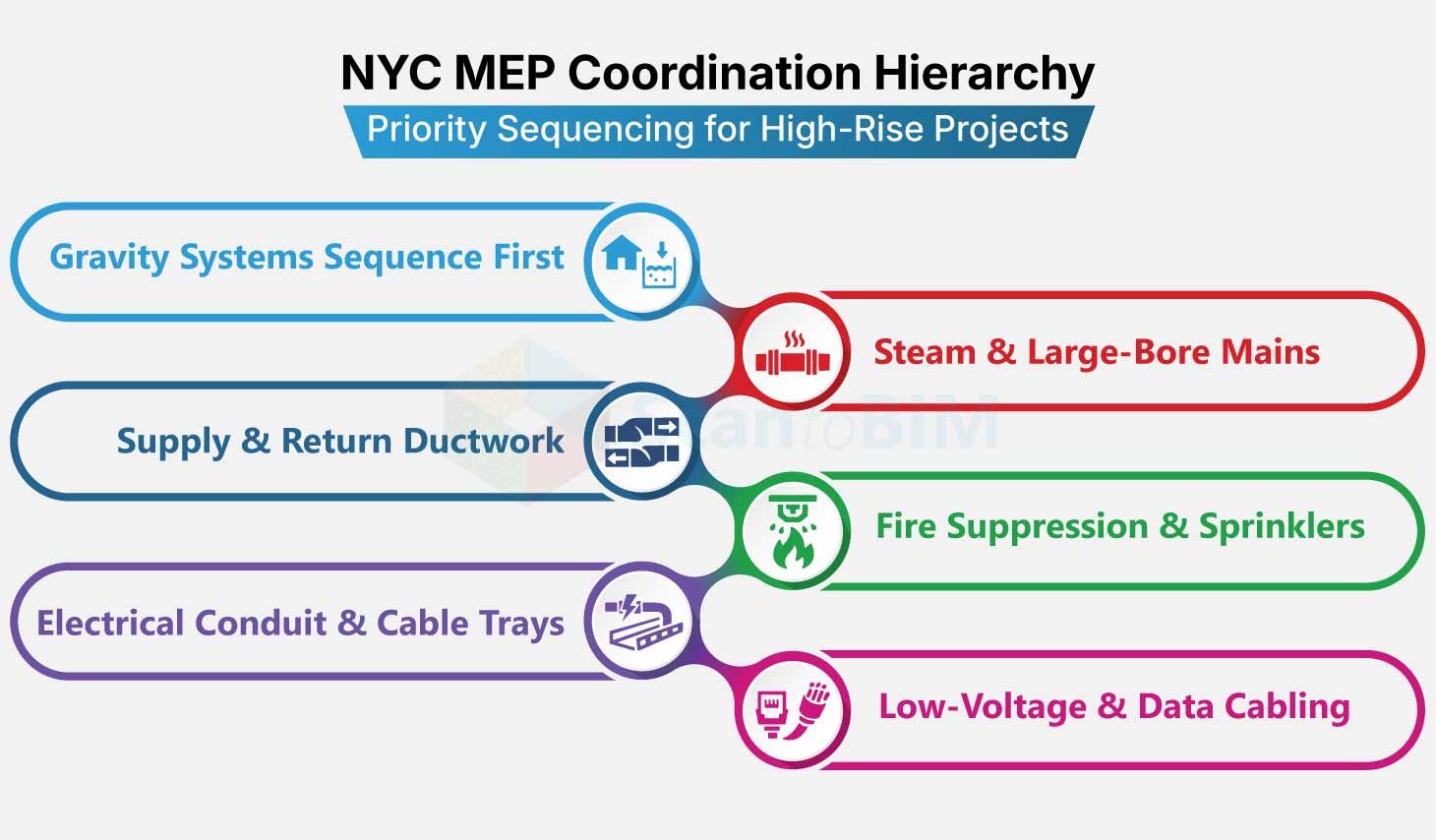
Manhattan buildings present a coordination challenge unlike anything found in low-rise construction. Floor plates pack MEPF systems into ceiling plenums that sometimes measure fewer than 18 inches from slab to finished ceiling. Steam distribution networks, a defining feature of pre-war high-rises across Midtown and the Financial District run parallel to modern chilled water lines, fire suppression mains, and low voltage conduit in the same interstitial space.
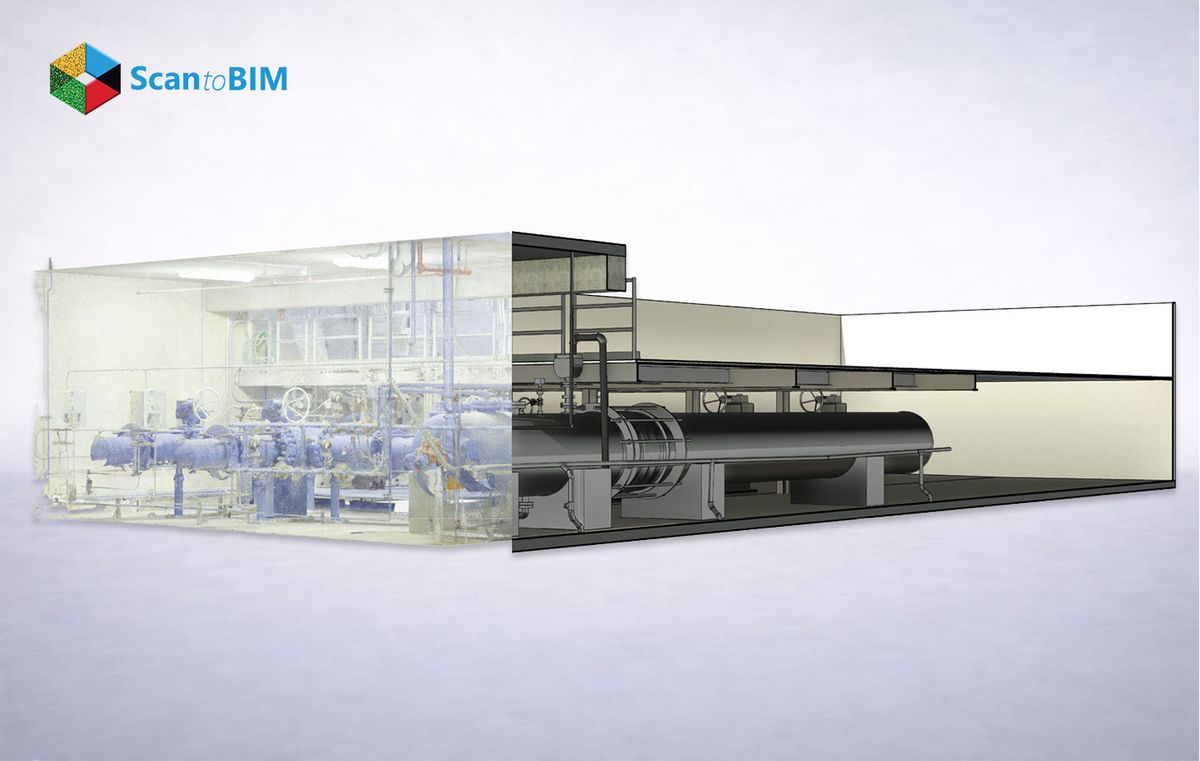
Scan to BIM Services cuts through this complexity by capturing every element at millimeter-level detail and delivering a unified coordination model that all project disciplines work from simultaneously. That single model environment transforms what was once a reactive, field process into a proactive, desk coordination exercise.
Scan to BIM for MEP coordination teams eliminates the reactive cycle of discovering clashes on the job site and replaces it with structured model resolution before construction begins.
- Clash detection before construction begins: MEP coordinators detect conflicts between MEP systems within the digital model. This approach prevents costly rework by resolving issues at the source.
- Accurate vertical riser documentation: Laser scanning captures riser shafts floor by floor. It provides structural and MEP engineers with an exact record of routing, clearances and penetration locations throughout the building height.
- Steam system mapping: Older NYC buildings carry Class A steam at pressures that demand exact spatial accounting. Scan to BIM documents steam mains, pressure reducing stations, traps and condensate returns with the accuracy fabricators need for shop drawing production.
- Centralized collaboration: BIM stakeholders work from a single Revit model anchored to real world conditions. This eliminates version control failures that often lead to downstream conflicts.
How accurate is Scan to BIM for HVAC and plumbing systems?
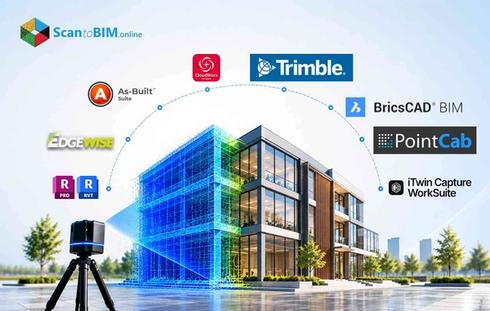
Accuracy is at the core of laser scanning value for MEP work. Modern terrestrial LiDAR scanners including the Leica RTC360, FARO Focus, and Trimble X7, capture spatial data at ±1 to 2 mm tolerance across their full working range. For HVAC and plumbing systems in high rise building systems nyc retrofits this level of accuracy translates directly into fabrication-ready geometry that field crews install without modification.
For tight plenum spaces in Manhattan office towers, millimeter-level capture means the difference between a duct section that arrives on-site and installs cleanly in a single operation versus one that requires field cutting, modification, and delays to other trades waiting in sequence behind it.
Four factors determine the final model accuracy that project teams receive:
- Scanner placement density: More scan positions per floor produce overlapping point clouds that eliminate shadow zones behind large equipment and in congested mechanical rooms.
- Registration quality: Proper target placement and registration in ReCap Pro or Leica Cyclone aligns all scan positions into a single unified coordinate system with deviation reports confirming alignment at every control point.
- Modeling discipline: A skilled Revit modeler traces ductwork, pipe, and conduit centerlines from the point cloud and applies correct family geometry rather than approximating from reference dimensions.
- QC verification: Independent checkers compare the finished Revit model against the raw point cloud at control points across every floor and mechanical room before delivery.
For plumbing systems specifically, Point cloud to BIM Modeling captures slope variations in drain lines. A detail that manual surveys miss entirely and that causes major installation errors in multi-floor stack configurations. The scanner sees the pipe geometry as it exists in three dimensional space, delivering slope data that allows plumbing engineers to confirm code compliance before a single fitting goes in.

Can laser scanning capture complex MEP systems in high-rise buildings?
Complex MEP systems in NYC present two scanning challenges that small scale projects rarely encounter: vertical continuity across many floors and safe access to occupied spaces. Laser scanning addresses both with a systematic field approach that experienced crews have refined across hundreds of NYC buildings.
Vertical Shaft Scanning
The field team scans each mechanical room and shaft access point from multiple positions to capture accurate spatial data. This process records the interior geometry of duct risers, plumbing chases, and electrical shafts as they extend from floor to floor. The resulting point clouds are combined into a single vertical model that clearly represents the entire structure. It shows exact routing paths, penetration locations and sleeve conditions at every floor level, providing the accurate data structural engineers need when working on riser shafts in existing buildings.
Occupied-Space Scanning
For MEP coordination BIM new york projects a single scan position with the Leica RTC360 captures a full 360-degree point cloud in under two minutes. A standard NYC office floor of 20,000 to 25,000 sq. ft. requires 15 to 25 scan positions, completing field capture in four to six hours with zero interruption to building occupants. This speed allows scanning teams to work during regular business hours in occupied towers, avoiding the premium costs of after hours access arrangements.
Mechanical Room Scanning
Chiller plants, air handling unit rooms, boiler rooms, and electrical switchgear rooms contain tightly packed arrays of equipment and piping that traditional surveying methods document poorly. Laser scanning captures every detail of housing in a single field operation, delivering complete and accurate data. This provides the geometric detail that fabrication teams and commissioning engineers need for replacement planning and sequence coordination.
What level of development (LOD) is required for MEP coordination models?
The Level of Development for a Scan to BIM MEP model depends directly on how the team intends to use the deliverable. NYC projects follow the AIA Level of development Specification and MEP work spans the full range from LOD 200 through LOD 500. Each level carries distinct requirements, costs, and downstream applications that project teams should understand before scoping a Scan to BIM engagement.
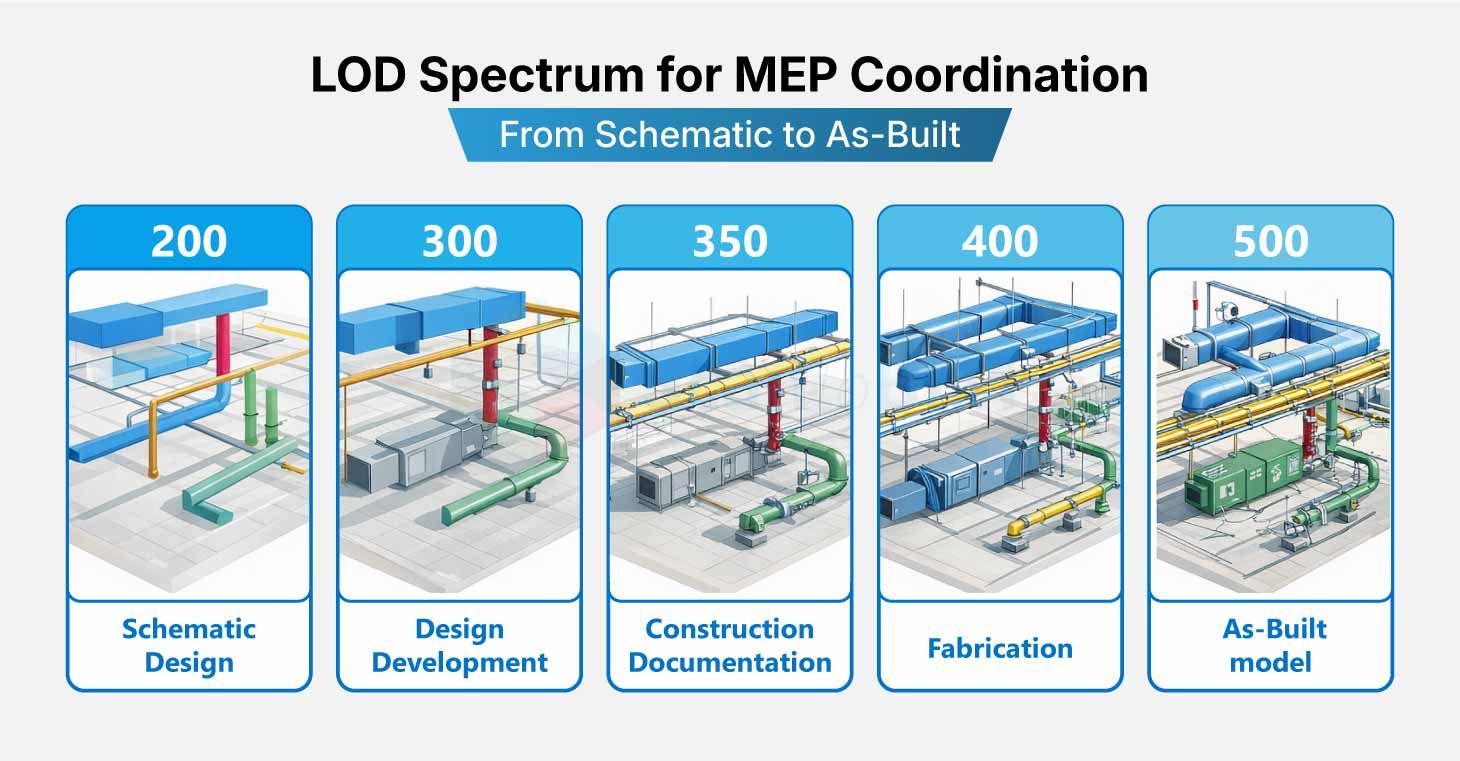
| LOD | Primary Use Case | MEP Application in NYC |
|---|---|---|
| 200 | Schematic Design | System routing concepts and spatial allocation across floors |
| 300 | Design Development | Accurate duct and pipe geometry, equipment placement, sizing |
| 350 | Coordination | Cross-discipline clash detection, connection interfaces, hanger systems |
| 400 | Fabrication | Spool drawings, ductwork shop drawings, modular mechanical assemblies |
| 500 | As-Built / FM | Facility management records, operations data, digital twin feeds |
Teams working on NYC renovation and high-rise projects must develop As-built BIM for MEP documentation to at least LOD 350 to ensure effective clash detection between disciplines.
Fabrication bound work including custom ductwork, pipe spools, and modular mechanical assemblies demands LOD 400. Where every component carries fabrication level geometry, connection details, hanger locations, and support specifications. The NYC Department of Buildings is increasingly accepting LOD 400 BIM submissions for permit applications involving complex mechanical systems. As a result project teams that invest in higher LOD models gain a clear advantage in faster approval timelines.
How much does Scan to BIM cost for MEP coordination in NYC?
Understanding Scan to BIM cost requires separating the investment into its two primary components: field scanning and BIM modeling. In New York City, both carry premiums that project owners should account for during budget planning and deliver returns that outpace their upfront cost on any project of meaningful size.
Field Scanning Costs in NYC
For Scan to BIM Services new york city engagements, Scanning crews operating in Manhattan, Brooklyn, or the Bronx work within prevailing wage structures on public contracts, and mobilization costs including equipment transport, parking coordination, security clearances, and building access logistics add line items that suburban projects avoid. A 50,000 sq. ft. NYC office floor scanning engagement runs between $8,000 and $15,000 for the field phase alone, depending on building access conditions and the number of dedicated mechanical spaces requiring coverage.
BIM Modeling Costs
Modeling costs scale with LOD and system complexity. An LOD 350 coordination model for a 50,000 sq. ft. floor with full HVAC, plumbing, fire protection, and electrical content runs between $20,000 and $40,000 in a standard NYC project scope. LOD 400 fabrication-level work carries a premium of 30 to 50% above LOD 350 costs, reflecting the additional geometry and connection detail required for shop drawing production.
The ROI Case for NYC Projects
The investment outweighs its cost across several measurable dimensions:
- Every clash resolved in the model prevents a field RFI that, in NYC's labor market, costs an average of $5,000 to $20,000 to resolve including premium craft labor, material restocking, and schedule impacts to downstream trades.
- Accurate documentation eliminates multiple return site visits by specialty contractors who carry full-day mobilization costs just to re-measure a space.
- Permit submission accuracy shortens DOB review cycles, which can otherwise add weeks to project timelines in complex mechanical and plumbing permit tracks.
- A 2025 Springer Nature study found that BIM workflows reduce overall project costs by an average of 15% and cut timelines by 20% figures that translate directly into dollar value on NYC's high-labor-rate projects (Das et al., 2025).
How long does a Scan to BIM project take for MEP systems?
Project duration for a Scan to BIM engagement in NYC follows a four-phase sequence, with total timelines ranging from two weeks for a single-floor renovation to twelve or more weeks for a full high-rise retrofit. Understanding the phases helps project managers sequence the Scan to BIM scope into their overall project schedule.
Phase 1
Field Scanning (1 to 5 Days)
The scanning crew mobilizes to site and captures all required floors, mechanical rooms, and shaft access points. A 50,000 sq. ft. office floor completes in one to two days of field work. Larger or more congested buildings require additional positions per floor, extending the field phase accordingly.
Phase 2
Data Registration & Processing (2 to 7 Days)
The field team registers all individual scan positions into a unified point cloud using ReCap Pro or Leica Cyclone. The registration team cleans noise, removes temporary obstructions, and validates the coordinate system alignment against the project survey datum.
Phase 3
Revit MEP Modeling (2 to 6 Weeks)
BIM modelers trace MEP systems from the registered point cloud in Autodesk Revit. MEPF disciplines each receive dedicated modeling passes followed by a coordination overlay in Navisworks for clash detection and resolution.
Phase 4
Validation & Delivery (3 to 7 Days)
QC reviewers compare the finished Revit model against the point cloud at control points across every floor. The delivery package includes the Revit model, raw point cloud, a clash detection report, and coordination drawings ready for trade contractor review.
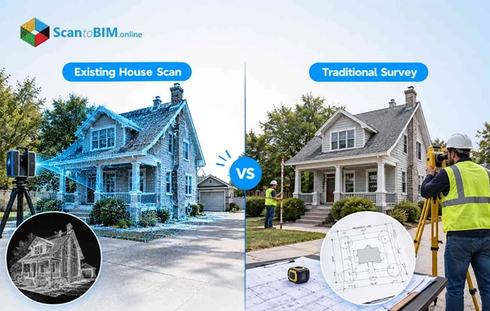
For a full-building NYC high-rise project covering 400,000 sq. ft. of mixed MEP systems, the total engagement runs ten to fourteen weeks from mobilization to final delivery. A fraction of the time that traditional survey and manual as-built documentation methods would require for the same scope.
Why is Scan to BIM important for renovation projects in NYC?
NYC renovation projects carry a distinct set of risks that make accurate existing-condition documentation a financial necessity rather than an optional enhancement. Buildings constructed before 1940 carry decades of undocumented MEP modifications. Contractors installed additional risers, rerouted steam mains, added electrical panels and modified original plumbing configurations across generations of tenant improvements all without updating as-built records.
This documentation gap represents one of the most common scan to BIM challenges that project teams face on NYC renovation work. Laser scanning eliminates the gap by delivering an accurate record of existing conditions before the design team commits to a single routing decision.
Local Law Compliance
NYC's Local Law 97 (carbon emission limits), Local Law 88 (lighting and sub-metering upgrades), and Local Law 126 (parking structure inspections) each require accurate documentation of existing MEP systems as a prerequisite for compliance planning. Project teams that enter a Local Law retrofit with outdated drawings spend weeks in exploratory demolition before design can begin. Scan to BIM eliminates this phase entirely, giving the design team a verified model before they write a single specification.
Historic Building Retrofits
Designated NYC landmarks in areas such as Midtown, the Upper West Side, SoHo, and Brooklyn Heights require careful MEP system routing to avoid impacting historic fabric. These projects must also meet the review and approval requirements of the New York City Landmarks Preservation Commission. The point cloud to BIM process captures both MEP systems and the architectural context at the same time. This provides preservation consultants and MEP engineers with a unified model for coordinated workflows and LPC documentation submissions.
Conclusion
Scan to BIM has become the operational standard for MEP coordination in New York City's most demanding renovation and large scale construction projects. The combination of accurate field data, structured coordination workflows, and fabrication-ready Revit deliverables gives project teams a foundation for accurate planning, faster permitting and conflict free installation. As Local Law requirements continue to drive MEP upgrades across the city's aging building stock, investment in Scan to BIM services delivers measurable returns in reduced rework, faster approvals, and better outcomes for owners, contractors, and occupants alike. The technology rewards structured execution, and NYC's most successful project teams have made it a standard line item rather than an optional service.