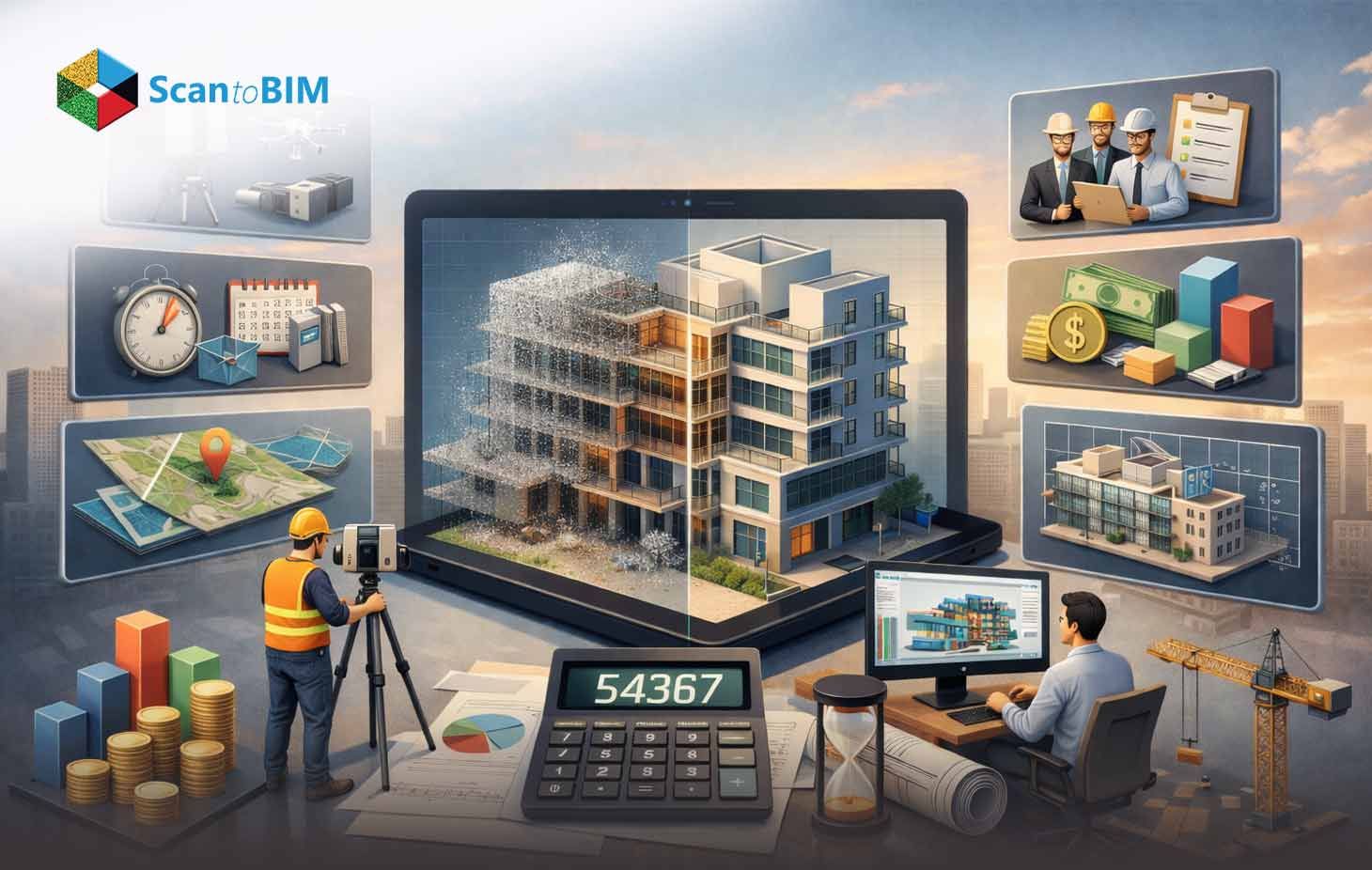
Scan to BIM services sit in an uncomfortable place for many decision-makers. You know they reduce renovation risk, improve coordination, and protect margins. And yet when the proposal arrives, the scan to BIM cost feels unpredictable. Two providers, same building, but a 40% difference in scan to BIM pricing.
In 2026, construction project ranges in the U.S. fall between $2,500 for small, simple buildings and $200,000+ for complex industrial or healthcare facilities. Whereas in Europe, mid to large commercial projects land between €38,000 and €175,000, depending on LOD and disciplines involved. Those numbers aren’t arbitrary. They reflect real modeling labor, QA protocols, and information management standards.
The structure of the scan to BIM process has also shifted. Field data capture now accounts for roughly 30% of total cost, while point cloud to BIM modeling and QA consume about 70% . Automation tools have reduced repetitive modeling effort by 30–40% in standard building types, but they haven’t eliminated expert validation.
This article breaks down scan to BIM services cost with clarity. What’s included, what drives pricing variation, realistic scan to BIM cost per square foot benchmarks, and when the investment truly pays off. And we will discuss when scan to BIM services are justified and when they are not.
Because accurate budgeting isn’t about finding the cheapest number. It’s about understanding what actually drives it.
What Is Included in Scan to BIM Pricing?
Before evaluating scan to BIM pricing factors, separate the work into two distinct phases. Many budgeting mistakes happen because teams treat it as a single activity.
Two-Phase Cost Breakdown
Field Data Capture: 30% of Total Cost
This covers:
- Laser scanning hardware and technician mobilization
- Site setup, scan positions, control points
- Travel, permits, safety coordination
- Initial documentation and data transfer
Scanning crews in major cities complete their work at hourly rates of $200 to $500. The daily rates of point cloud to BIM modeling services range between $3,200 and $5,000. The rates depend on the difficulty level of the work. The minimum mobilization fees start between $2,500 and $3,500.
Field work is visible and tangible. But it’s rarely the primary cost driver.
BIM Modeling & Processing: 70% of Total Cost
The majority of scan to BIM services cost sits here:
- Point cloud registration and cleanup
- Element extraction and modeling
- Architectural, structural, and MEP modeling
- Discipline coordination
- QA/QC validation
- Deliverable preparation per requirement (Revit, IFC, COBie)
Modeling rates in 2026 typically range between $50–$150 per hour. Daily rates range from $800–$1,200 per modeler. Cost depends on discipline and LOD.
The friction point in scan to BIM pricing is not scanning. It’s modeling precision.
Scan to BIM Pricing Factors: Inclusions, Exclusions & Pricing Models
Inclusions vs. Exclusions
| Category | Item | Typically Included in Base Quote? | Why It Matters |
|---|---|---|---|
| Core Modeling | Base model creation | ✅ Yes | Forms the primary BIM geometry derived from point cloud data |
| Deliverables | Standard LOD deliverables (e.g., LOD 200–300) | ✅ Yes | Supports design development and coordination workflows |
| Quality Control | Basic QA/QC | ✅ Yes | Ensures dimensional accuracy and model consistency |
| MEP Detail | Small-diameter piping / conduit | ❌ Often Extra | High modeling effort; frequently excluded in low-cost quotes |
| Site Work | Extensive additional site visits | ❌ Often Extra | Travel and re-mobilization increase field costs |
| Timeline | Rush delivery | ❌ Often Extra | Overtime modeling and compressed QA cycles increase cost |
| Data Enrichment | Detailed FM tagging / asset metadata | ❌ Often Extra | Required for facility management but not standard in base scope |
| Revisions | Multiple revision rounds | ❌ Often Extra | Additional iterations add modeling and coordination hours |
Common Scan to BIM Pricing Models
| Pricing Model | Best Suited For | Risk Level | Budget Predictability | Typical Use Case |
|---|---|---|---|---|
| Per Square Foot | Standard buildings with predictable scope | Low - Medium | High | Commercial offices, multi-family residential |
| Per Day Rates | Complex or evolving renovation sites | Medium | Moderate | Hospitals, historic buildings, phased projects |
| Fixed Project Fee | Clearly defined LOD and disciplines | Low (if scope locked) | Very High | Institutional projects with detailed RFPs |
Key Factors That Influence Scan to BIM Cost
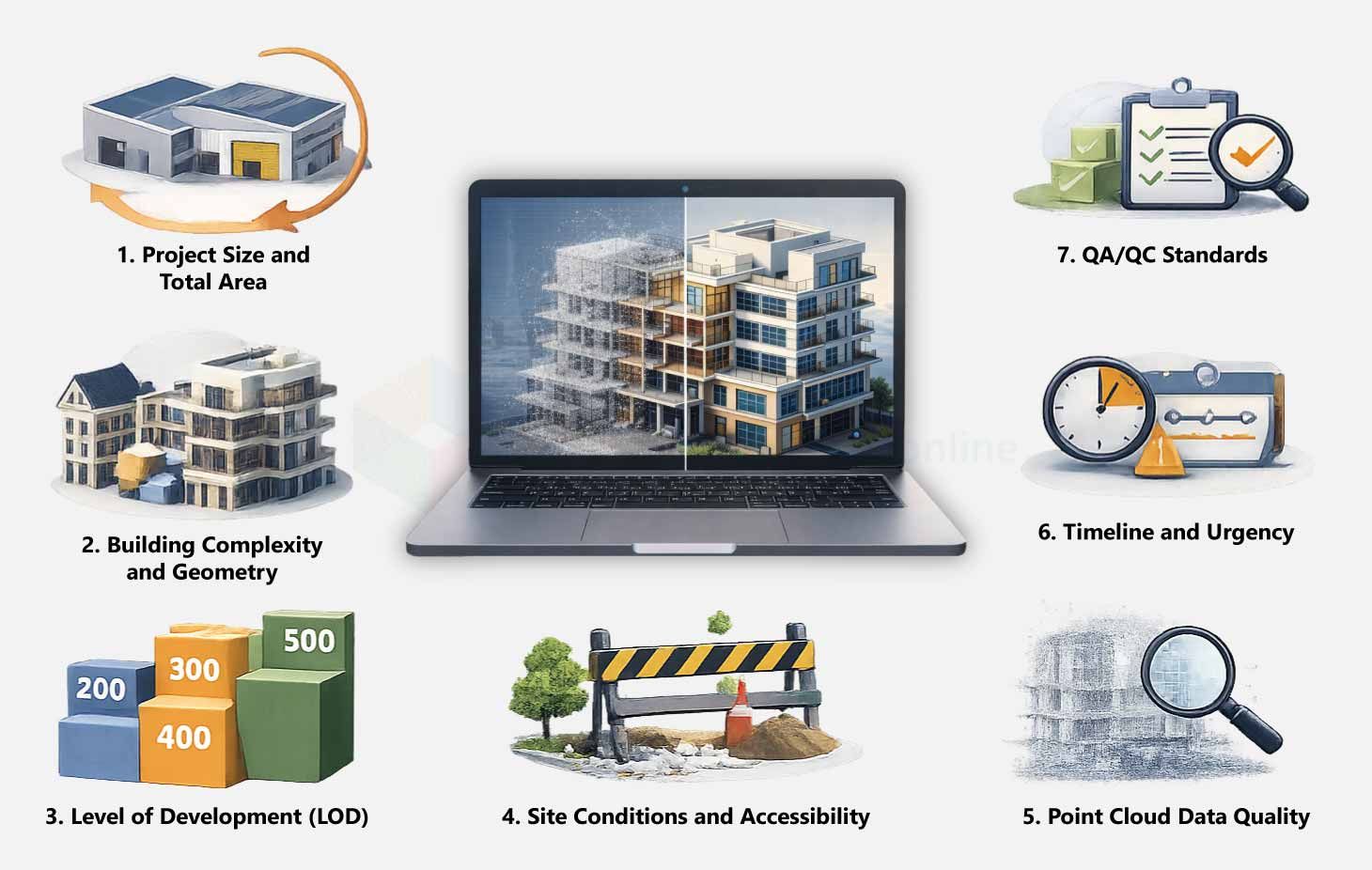
When scan to BIM pricing factors varies, it’s almost always traceable to one or more of the following seven drivers.
1. Project Size and Total Area
Square footage acts as a baseline multiplier. Larger projects require more scan positions and modeling hours. However, complexity can outweigh area. A 20,000 sq ft hospital floor often exceeds the scan to BIM cost of a 100,000 sq ft warehouse shell.
2. Building Complexity and Geometry
Irregular geometry increases modeling time. Examples:
- Curved facades
- Historic ornamentation
- Sloped slabs
- Dense plant rooms
Dense MEP systems multiply point cloud to BIM modeling effort significantly.
3. Level of Development (LOD)
According to BIMForum’s LOD Specification ( buildingSMART aligned), higher LOD requires more element accuracy and verification. Under ISO 19650 principles, information requirements must be clearly defined at project outset.
Cost impact typically follows:
- LOD 200: baseline
- LOD 300: 1.5–2x baseline
- LOD 350: 2–3x
- LOD 400–500: 3–5x
Higher LOD means more modeling detail and more QA validation.
4. Site Conditions and Accessibility
Remote sites, active hospitals, or high-security facilities introduce constraints:
- Off-hour scanning
- Safety coordination
- Restricted equipment access
These factors can increase scanning day rates by 30–50%.
5. Point Cloud Data Quality
Clean scans reduce modeling hours. Poor registration increases rework. The scan to BIM process follows a simple principle: modeling efficiency depends heavily on capture quality.
Experienced scanning teams reduce overall scan to BIM services cost.
6. Timeline and Urgency
- Standard turnaround: 4-8 weeks
- Urgent delivery (2-4 weeks): May include 20-40% additional pricing
Automation can compress timelines, but QA validation remains manual-intensive for higher LOD projects.
7. QA/QC Standards
Contract-document-grade deliverables require:
- Independent model checks
- Clash validation
- Tolerance confirmation
These steps add 15–25% modeling time but significantly reduce downstream risk.
These are legitimate cost drivers. The frustration often stems from unclear communication, not inflated effort.
Scan to BIM Cost Breakdown by Project Type
Below are realistic 2026 benchmarks for scan to BIM cost per square foot across project types.
| Project Type | Typical Size Range | Typical Cost Range (USD) | Scan to BIM Cost Per Sq Ft | Typical LOD | Complexity Level | When It Makes Financial Sense |
|---|---|---|---|---|---|---|
| Small Residential (Single-Family) | 2,000–4,000 sq ft | $2,500–$8,000 | $0.50–$2.00 | LOD 200–300 | Low–Moderate | Historic homes, complex additions, high-risk renovations |
| Multi-Family Residential | 10,000–30,000 sq ft | $8,000–$35,000 | $0.60–$1.20 | LOD 200–300 | Moderate | Repetitive layouts needing accurate floor coordination |
| Commercial Office Buildings | 20,000–100,000 sq ft | $15,000–$80,000 | $0.50–$1.50 | LOD 300–350 | Moderate | Tenant improvements, renovation planning, MEP coordination |
| Retail & Mixed-Use | 15,000–60,000 sq ft | $12,000–$50,000 | $0.80–$2.50 | LOD 300–350 | Moderate–High | Façade complexity, multi-tenant retrofits |
| Industrial & Manufacturing | 50,000–200,000+ sq ft | $40,000–$200,000+ | $0.80–$3.00+ | LOD 300–400 | High | Dense pipe racks, structural steel, equipment-heavy zones |
| Healthcare & Institutional | Varies (often 30,000+ sq ft wings) | $100,000–$300,000+ | $1.50–$10.00+ | LOD 350–400+ | Very High | Hospitals, labs, critical MEP environments where clash risk is costly |
Healthcare sits at the high end because dense MEP and coordination risk demand higher LOD and QA rigor.
A $150,000 scan to BIM investment on a hospital renovation that prevents two major coordination clashes can easily offset itself. Dodge Construction Network reports that 99% of specialty contractors see profit margin erosion. About one-third of that erosion ties to unplanned rework. Healthcare environments are dense. MEP routing is tight. Phasing constraints are strict. A few preventable clashes can trigger schedule delays. Teams face resequencing costs. Margins compress.
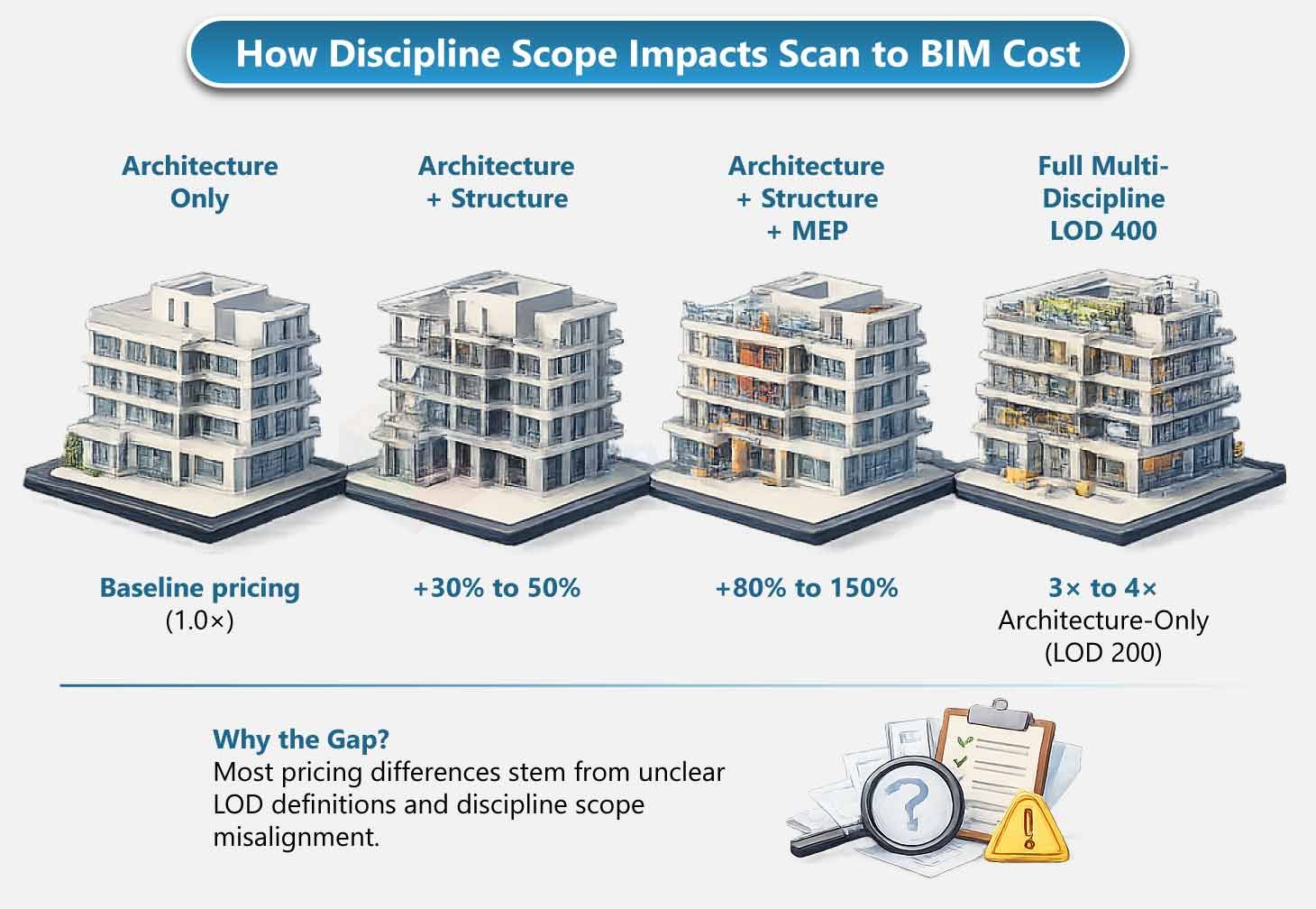
Project type matters. But LOD and discipline scope often matter more.
Pricing Differences by LOD (Level of Development)
2026 modeling rates and 2025 per-area benchmarks show clear cost differences across LOD levels. Modeling depth increases. Coordination effort rises. Verification time expands.
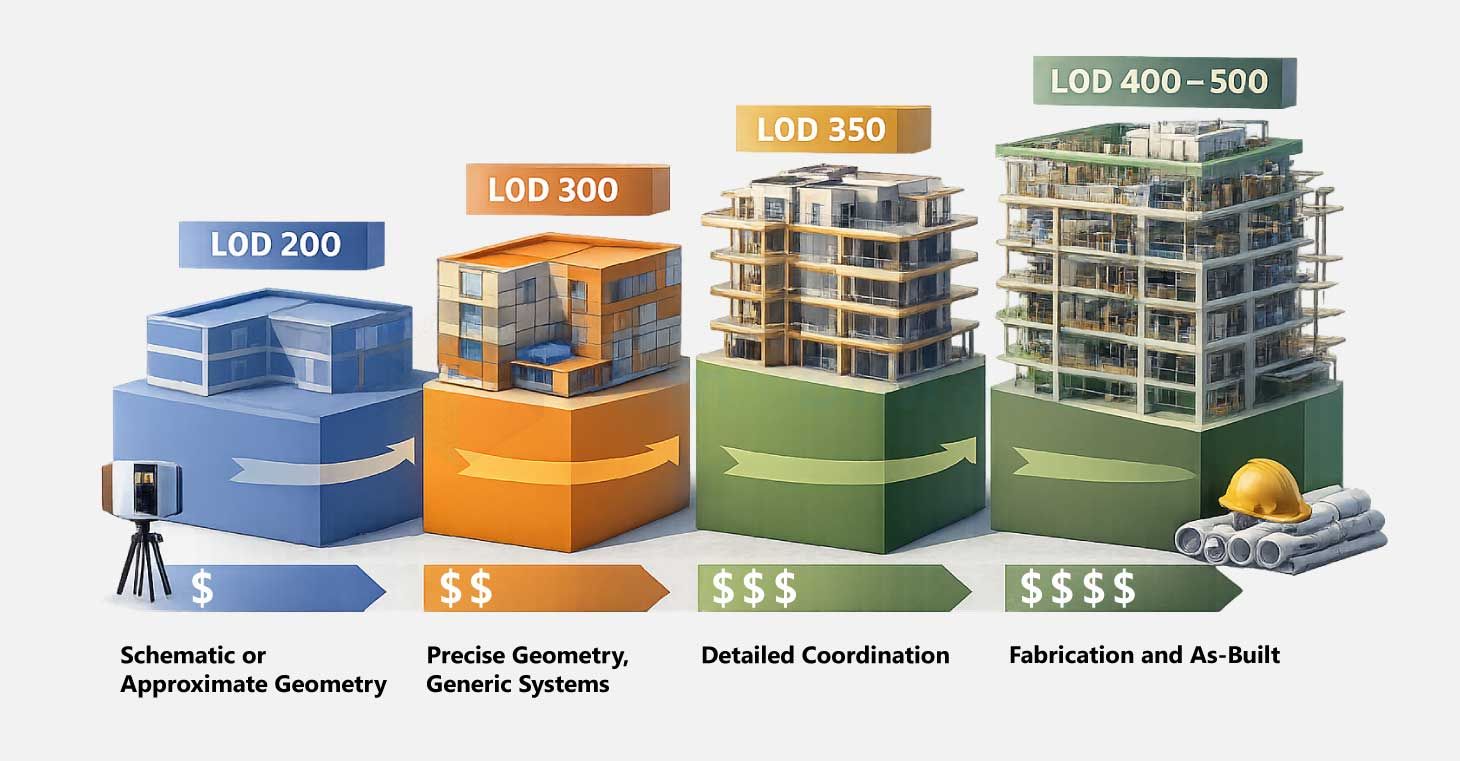
LOD 200: Schematic or Approximate Geometry
Used for early design validation, feasibility reviews, or initial renovation planning. The model captures overall massing, primary walls, slabs, roofs, and major openings based on scan interpretation, with minimal system detail.
Cost multiplier: Baseline (1.0×).
Price range: About $0.40-$0.80 per sq. ft. for straightforward commercial buildings. Rates may drop for large, simple shells.
LOD 300: Precise Geometry, Generic Systems
Teams apply this level during design development. Architectural and structural coordination occurs here. Elements are dimensionally accurate. Elements align across levels. Models include primary penetrations and system layouts.
Cost multiplier: Around 1.5 to 2 times LOD 200 for the same building conditions.
Price range: $0.80 -$2.00 per sq. ft. for office, retail sector, or multi-family projects that include structural detail.
LOD 350: Detailed Coordination
Teams require this level for construction documentation. Clash detection becomes structured. Modeling includes secondary framing. Interface conditions are defined. Penetrations are modeled. MEP routing is coordinated within service zones.
Cost multiplier: Typically 2 to 3 times LOD 200 baseline once coordination depth increases.
Price range: $2.00 -$5.00+ per sq. ft. for complex or multi-discipline facilities.
LOD 400–500: Fabrication and As-Built
Used for fabrication models and installation-level detailing. Teams also use it produce FM-ready as-built documentation. Geometry reflects exact routing. Supports and hangers are modeled. Field conditions are verified. Equipment data is embedded.
Cost multiplier: Commonly 3 to 5 times LOD 200 , higher for specialized systems such as medical gas or process piping.
Price range: $3.00 -$10.00+ per sq. ft. for dense industrial or hospital environments.
Scan to BIM Cost per Square Foot: What to Expect
Cost per square foot remains the most common benchmarking method in scan to BIM pricing factors. It supports quick early-stage budgeting comparisons. It should not be treated as a fixed rule. Final figures shift with scope definition. LOD requirements affect pricing. Discipline coverage changes totals.
Scan to BIM Cost per Square Foot 2026 U.S. Benchmarks
- Low complexity: Warehouses, simple shell - $0.40-0.80/sq. ft.
- Medium complexity: Office, retail sector, multi-family - $0.80-2.00/sq. ft.
- High complexity: Healthcare, dense MEP, heritage - $2.00-8.00+/sq. ft.
- Ultra-complex: Active hospitals, refineries - $8.00-15.00+/sq. ft. in specific zones
- European: €5-50/m² depending on complexity
What Drives the Increase
- MEP density and ceiling congestion
- Equipment modeling requirements
- Higher LOD (350–400) fabrication-level detail
- Multi-discipline coordination workflows
- Strict QA/QC and compliance standards
What May or May Not Be Included
- Gross floor area vs. selective modeled areas
- Roof structures and façade systems
- Exterior/site elements
- Small-diameter piping and conduit
- Hangers and supports
- FM-level asset tagging
- Additional revision rounds
- Accelerated delivery timelines
Scan to BIM cost per square foot works best as a comparative planning tool. Decision-makers must review the assumptions behind the number. A lower unit rate may exclude coordination-heavy elements. That gap often leads to change orders.
A slightly higher per square foot cost tied to defined LOD standards reduces rework risk. Disciplined QA workflows add control. Teams protect schedules. Teams avoid field clashes. The metric shifts toward cost certainty.
Common Pricing Mistakes and Hidden Costs
Scan to BIM budgets rarely fail because of math. They fail because of assumptions. We’ve seen well-structured projects derail once coordination exposes what was never modeled. And by then, the contract is already signed.
The “Too Cheap to Be True” Trap
2026 cost guides and practitioner commentary continue to flag rock-bottom pricing as a warning sign.
The pattern is predictable:
- Key systems excluded (pipes below a set diameter, secondary steel, equipment supports).
- QA/QC reduced to visual checks rather than structured validation.
- Deliverables limited to raw geometry without annotation or COBie-ready data.
Hourly offshore modeling at $10–15/hr looks attractive compared to $50 - $125/hr in U.S./EU markets. But when clash detection begins and missing sleeves or undersized ductwork surface, the savings disappear. Rework erodes margins. Quickly.
Unclear Scope Definition
Most disputes trace back to vague scope language.
- MEP included without pipe size thresholds.
- Informal LOD descriptions instead of BIMForum standards
- No clarity on Revit version, native files, COBie, or 2D sheet requirements.
And yet proposals still bundle everything into a single lump sum. Better practice in 2025–2026 separates:
- Scanning vs registration vs modeling
- Discipline scope (Architecture / Structure / MEP)
- LOD per discipline
- QA/QC methodology
That level of breakdown changes negotiation dynamics.
Minimum Mobilization Fees
Most providers apply a $2,500 - $3,500 minimum mobilization threshold for small projects. Below roughly 1,500-2,000 sq ft, per-foot pricing spikes because fixed setup costs are spread thin.
So small residential projects often appear “overpriced.” They aren’t. The math just compresses poorly.
Change Orders and Scope Creep
Scope creep rarely arrives dramatically. It creeps in.
- Poor scan quality requiring re-visits
- Mid-project discipline additions
- Additional fixture modeling request
- Shift from 3D model to annotated CD set
Strong 2026 contracts define hourly/day rates for changes and list explicit exclusions to calculate scan to BIM services cost. For example, pipes under 1 inch. Specificity protects both sides.
Automation and AI Pricing Hype
Automation is real. Case studies show up to 40% cost reductions. Time savings range from 50% to 70% for standardized LOD 200 - 300 workflows. Tools handle about 60% to 80% of repetitive tasks. Expert judgment covers the remaining 20% to 40%.
Outsourcing Quality Variability
Nearshore or offshore teams can reduce hourly cost by 25% -50%. But quality varies.
- Look for documented QA workflows.
- Ask for point-cloud-backed samples.
- Check repeat clients.
Mid-priced partners often outperform both extremes. Cheap enough to beat in-house costs. Experienced enough to protect coordination integrity.
That balance matters more than the headline rate.
Conclusion: How to Budget for Scan to BIM in 2026
Budgeting for Scan to BIM in 2026 starts with project fit. We have seen projects over 5,000 sq ft absorb mobilization costs efficiently, especially where MEP density or renovation risk is high. In occupied hospitals or industrial plants, a single avoided coordination failure can outweigh the modeling fee. Research continues to link rework with measurable margin erosion. That risk calculus matters.
Full multi-discipline LOD 400 is not required for every building. Small residential projects under 2,000 sq ft may function with targeted modeling. Simple warehouse shells may rely on conventional survey methods. Workflow and tolerance requirements drive the decision.
Strong budgeting discipline helps. Align scope with BIM Forum LOD definitions. Separate scanning, registration, and modeling costs. Price disciplines independently. And carry a realistic 10% - 15% contingency when scope uncertainty exists. That buffer protects schedules more than it inflates budgets.
Automation improves efficiency year over year. Hybrid workflows still dominate complex coordination. Decision-makers should evaluate providers on QA structure, portfolio depth, and revision management. Per-square-foot rates tell only part of the story.
When matched to the right project profile, scan to BIM services cost isn’t overhead. It’s risk control priced upfront instead of paid later.