Introduction: Point Cloud to BIM Technology in 2026
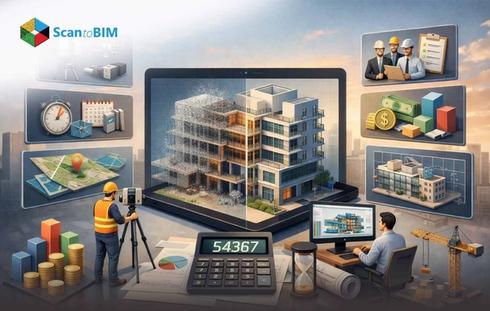
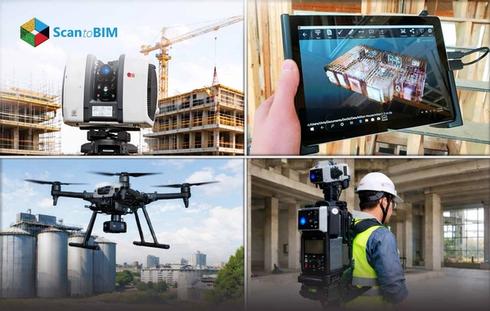
Point Cloud to BIM stands as a standard digital workflow across AECO industry in 2026 What was once treated as a specialist service is now embedded in everyday project delivery. These Construction projects depend on 3D Laser scan based data to address missing drawings, outdated records, and unreliable manual measurements. LiDAR scanner, drones, and mobile scanning systems. It captures millions of scanned data with millimeter-level acc which produces an accurate digital record of existing conditions before any design or construction activity begins.
These highly detailed point cloud datasets are converted into structured BIM models that support design coordination, clash analysis, construction sequencing and prefabrication planning. Model accuracy directly affects schedule, material coordination, and site execution particularly in complex or constrained environments. The ability to translate real-world geometry into usable BIM elements reduces uncertainty for project teams. It improves coordination across architectural, structural, and MEP disciplines without repeated site visits.
The industry wide shift toward data-driven delivery, cloud collaboration and digital twins positions point cloud scan to bim workflows at the core of modern BIM execution. BIM professionals are now expected to understand scan validation, modeling intent, and data application across the project lifecycle. This capability functions as a baseline technical requirement. It supports coordination, lifecycle management, and connected project ecosystems.
Automation Trends in Point Cloud to BIM Workflows
By 2026 automation directly handles geometry extraction from registered point clouds rather than assisting manual tracing. Modeling engines detect planar surfaces to generate walls and slabs. It aligns columns using verticality analysis, and places structural elements based on scan density and deviation thresholds. MEP automation identifies pipe runs, ducts, and trays using diameter recognition and connectivity logic, allowing rapid creation of baseline systems from dense scan datasets instead of manual point selection.
Workflows now follow controlled technical stages: scan registration, noise classification, object segmentation, parametric element creation, and rule-based validation. Automation accelerates repetitive modeling, while BIM Coordinators manage Level of Development compliance, coordinate disciplines, and verify interoperability across platforms. These task-level changes define current BIM automation trends, where software executes geometry creation and professionals control accuracy, constructability, and coordination readiness.
AI and Machine Learning in Scan to BIM
AI now drives feature detection and classification within point cloud datasets. Machine learning algorithms analyze geometry patterns, point density and spatial relationships helps to identify building elements. These systems generate preliminary BIM elements automatically reducing manual interpretation during early modeling stages. Object recognition focuses on shape continuity, orientation, and connectivity instead of simple point proximity. It allows faster baseline model generation from detailed scans.
Approximately in 2026 27% of AEC firms globally use AI for automation and decision-making, and 87% of contractors believe AI will meaningfully transform business operations. The continued advancement of BIM is supported by the oversight of BIM professionals.
AI-assisted modeling also supports predictive analytics by using historical scan and BIM data to flag coordination risks and sequencing conflicts earlier. This defines current AI in point cloud to BIM workflows where intelligence accelerates decisions while professionals control accuracy, tolerances, and constructability interpretation.

Accuracy and Quality Improvements in BIM Models
Accuracy remains the primary technical advantage of scan derived BIM models across complex project environments. Laser scanners capture existing conditions with millimeter-level resolution which reduces dependence on outdated drawings and manual site measurements. Multi-sensor data fusion improves surface visibility and fills geometric gaps in congested plant rooms, ceiling voids, and infrastructure corridors. Point cloud–based models are now delivered against defined LOD requirements and BIM Execution Plans, supporting consistent validation and coordination. Mature BIM adoption has demonstrated reductions of up to 40% in onsite clashes and 15–20% in rework costs in documented projects. Highly detailed 3D BIM models also support prefabrication and modular construction; projects using BIM-driven prefabrication report construction time reductions of 20–50%, along with notable decreases in material waste due to improved coordination and dimensional control.
Accurate scan-based models also support tolerance verification and constructability review before fabrication begins. Teams use point cloud overlays to confirm clearances, alignment, and installation zones for structural and MEP systems. This approach reduces field adjustments during installation and improves confidence in prefabricated assemblies. Consistent geometric accuracy across disciplines improves clash resolution quality and supports downstream uses such as quantity takeoffs, sequencing analysis, and facility documentation, where dimensional reliability directly affects planning and operational decisions.
Cloud-Based Point Cloud Processing and Collaboration
Cloud-first workflows now define how point cloud and BIM data is managed across project teams. Centralized Common Data Environments store point clouds, BIM models, coordination files, and project metadata in a single workspace, allowing real-time access for distributed disciplines. Version control, model history tracking, and shared issue management reduce coordination conflicts and limit data misalignment during active design and construction phases.
Owners increasingly mandate cloud collaboration and digital delivery as contractual requirements. Implementing a CDE directly impacts cost control, as rework typically accounts for 5–15% of total project costs. Cloud platforms handle large point cloud datasets that exceed local hardware limits and support integrated workflows. The integration of scan processing, BIM authoring, coordination, and collaboration tools defines current scan to BIM technology trends rather than dependence on isolated software.
Cloud environments also support incremental scan updates and continuous model synchronization during construction and operations. Teams upload progress scans to compare as-built conditions against coordination models, allowing early deviation detection. Role-based access controls manage permissions for sensitive datasets. While audit trails track model changes across disciplines. Cloud-based processing offloads scan registration, clipping, and segmentation from local machines, improving performance with datasets. These platforms create direct links between coordination issues, model elements, and field observations, improving traceability from scan data to resolution. This capability improves decision speed without increasing data duplication or local infrastructure overhead.
Integration with Digital Twins and Facility Management
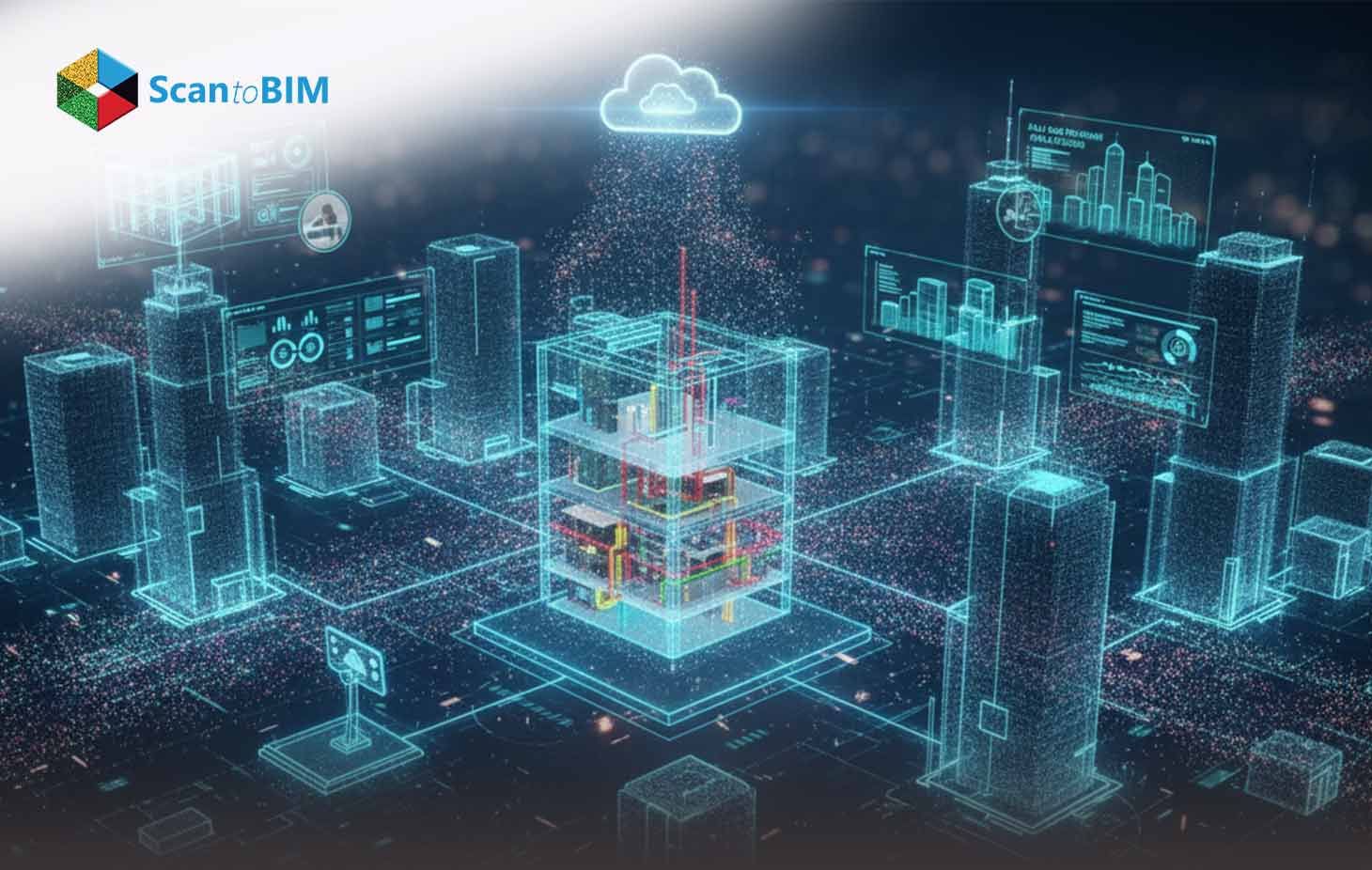
Point Cloud to BIM models now serve as the geometric and data backbone for digital twins, extending model use beyond design and construction into live operational environments. These models connect BIM data with real-time IoT sensor inputs which supports continuous asset monitoring and performance analysis. This integration reflects point cloud to BIM trends 2026, where models function as active data systems rather than static records. Around 52% of AEC leaders are implementing digital twins, increasing to nearly 67% among owners and facility managers, and 66% of owners using digital workflows report better-informed decision-making when managing complex assets.
Digital twin use cases enabled by Point Cloud to BIM include
- Space utilization analysis for operational efficiency
- Energy consumption monitoring and optimization
- Lifecycle performance tracking across facilities
- Predictive maintenance based on real-time performance data
- Structural health monitoring using sensor-linked geometry
- Equipment performance tracking and fault detection
- Compliance reporting for safety and regulatory audits
- Asset lifecycle cost analysis and capital planning
- Real-time condition assessment for renovation planning
Digital twins built from point cloud–derived BIM models also support long-term facility planning and operational resilience. Accurate as-built geometry improves system mapping and asset traceability across complex facilities. Continuous data updates helps performance trends, identify degradation patterns and plan interventions before failures occur. This capability improves coordination between Stakeholders. While supporting informed capital investment decisions. As operational requirements grow more data-driven, point cloud–based digital twins become central to maintaining asset reliability, efficiency, and lifecycle transparency.
Challenges and Limitations of Emerging Technologies
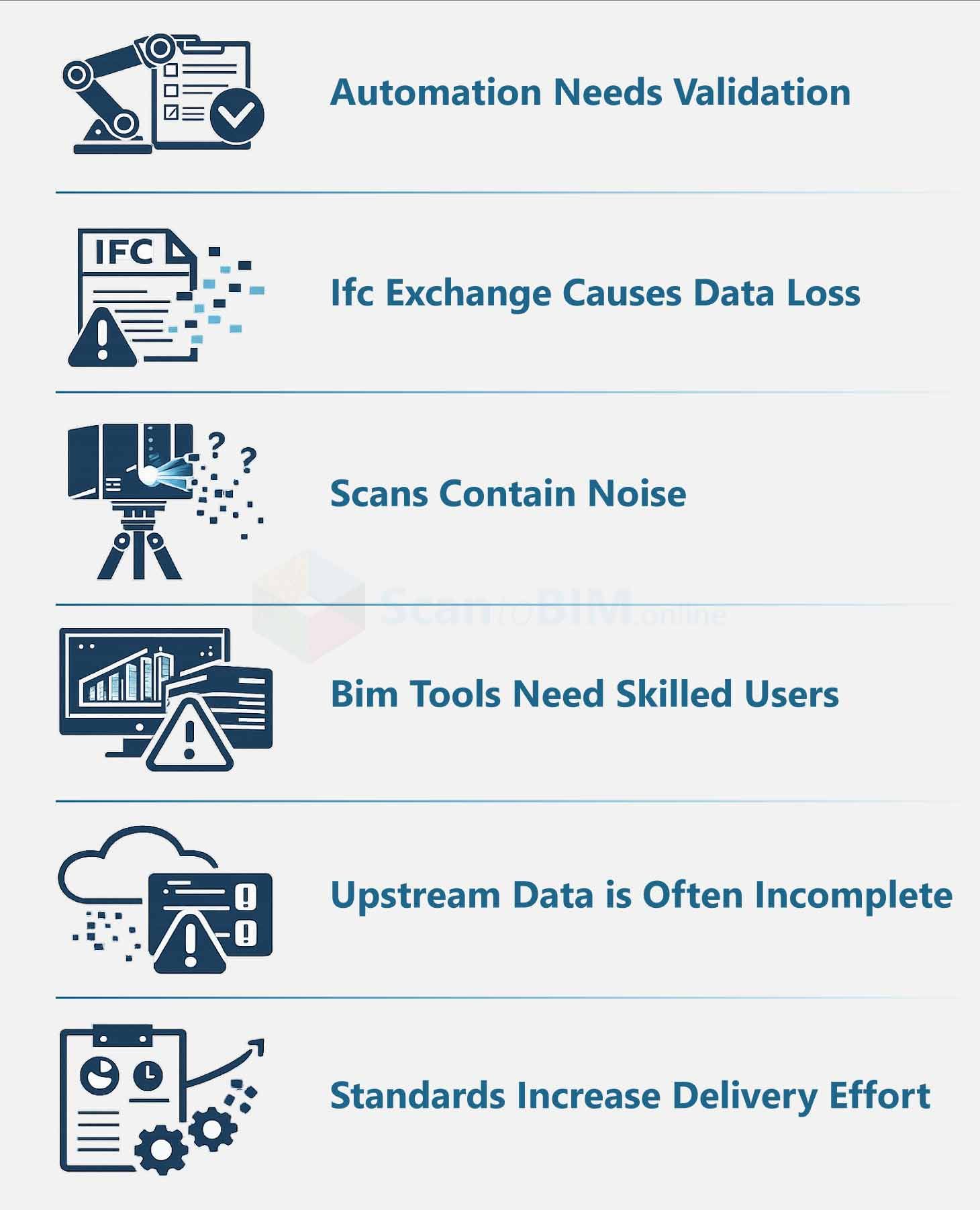
- Scan noise and occlusions reduce usable geometry in congested environments
- Over-dependence on automation introduces errors when validation steps are skipped
- Compatibility challenges arise when exchanging data between platforms using IFC and proprietary formats.
- Skill gaps affect scan registration accuracy, coordinate control, and tolerance interpretation
- Hybrid delivery models combining BIM, DWGs, PDFs, and spreadsheets continue due to inconsistent data quality
- Construction standards are becoming mandatory with increasing focus on ISO 19650 workflows and IFC/ISO 16739 data exchange.
These limitations require disciplined workflow control, clear validation ownership, and strong technical oversight across all project stages. Teams must define modeling intent early, set tolerance thresholds, and schedule validation checkpoints to prevent automated errors from propagating into coordination models. Interoperability constraints require careful data exchange planning and format testing. When IFC deliverables are contractually required. Skill gaps further increase risk when scan processing, coordinate management, or tolerance interpretation is misunderstood. These issues reduce model reliability, slow coordination cycles and limit the effectiveness of construction and operational workflows.
Conclusion: Preparing for Point Cloud to BIM in 2026
Point Cloud to BIM sits at the center of connected data-driven construction ecosystems in 2026. Adoption accelerates. Projects demand accurate as-built data for design, construction, and operations. The global Scan to BIM services market is projected to reach US$673 million by 2031. The market grows at a 5.3% CAGR. The data shows sustained industry demand. The global BIM market was valued at USD 5.58 billion in 2025 and is projected to reach USD 15.01 billion in 2026 positioning BIM as core project infrastructure.
Across the industry in 2026 more than 60% of large construction companies use BIM. About 55% apply clash detection workflows. Point cloud–derived BIM models support digital twins. The models support prefabrication. The models support infrastructure upgrades. The models support long-term asset performance. BIM professionals now focus on readiness. Teams control validation workflows. Teams understand automation limits. Teams deliver data-rich models for downstream use. Automation continues to advance. Demand rises for skilled coordinators. These coordinators run point cloud to BIM modeling services in complex, multidisciplinary project environments.
If your projects are shifting from simple modeling toward coordinated, data-driven delivery, this is where practical alignment begins.