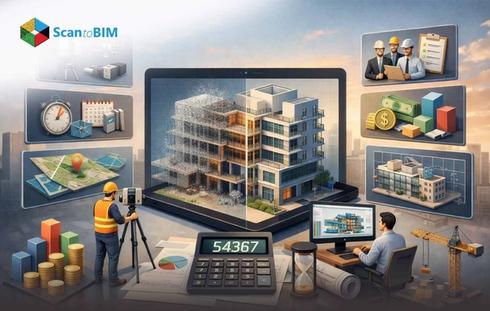
Scan to BIM converts laser scanned point clouds into 3D BIM models of the physical space. Terrestrial laser scanners and LiDAR systems capture millions of spatial data points per second, surfaces recording, elevations, structural geometry and MEP layouts with high density. Technicians register and clean the captured data then convert them into building elements using advanced tools like Autodesk Revit and Navisworks. The output becomes a coordinated digital replica of field conditions rather than an interpretation of outdated 2D drawings.
Across the United States renovation, retrofit, healthcare, airports, education modernization, and industrial rehabilitation projects depend on verified as-built BIM models. Teams demand millimeter-level accuracy because even small geometric deviations affect clash detection, prefabrication, and equipment clearance validation. Federal adoption milestones including the 2007 BIM initiatives by the U.S. General Services Administration and the 2016 National BIM Standard United States. It pushed LOD 300–500 existing-condition modeling into mainstream procurement requirements.
Highly detailed scan data directly influences clash detection, quantity takeoffs, 4D sequencing and 5D cost planning. If point cloud registration lacks precision or modeling ignores defined tolerances, coordination results become unreliable. Leading firms follow E57 standards for scanned data exchange and apply discipline-specific codes such as ASME B31.3 when modeling piping systems in industrial environments. Accuracy at the scanning stage controls reliability across the entire BIM lifecycle.
Scan to BIM services USA pricing ranges between $0.15–$0.35 per square foot, $150–$250 per hour, or fixed lump-sum packages depending on scope, LOD, and tolerance requirements. Scan to BIM cost factors alone does not indicate capability. Vendor selection affects constructability reviews, fabrication planning, and facility data continuity. The right company delivers controlled tolerance, documented QA workflows, and coordination-ready models aligned with project objectives.
Why Scan to BIM Quality Matters in Commercial Projects
Commercial projects operate within tight service clearances, dense MEP corridors, and limited shutdown windows. Laser scan to revit quality directly affects constructability validation. Laser scanners capture millions of spatial points per second but registration accuracy determines whether that data translates into coordination ready geometry. When technicians achieve sub-3 mm RMS registration and align scans to verified control points the resulting BIM model reflects real slab deflections, beam camber, and live system offsets rather than theoretical alignment. That level of geometric control allows design teams to base routing and equipment placement on measured reality instead of legacy drawings.
Quality also affects downstream analytical workflows. Early cloud to cloud comparison between existing and proposed geometry identifies deviations before issuing IFC packages. Accurate as-built BIM models feed quantity extraction, 4D sequencing logic and 5D cost simulations without distortion from positional error. In high-value commercial assets such as hospitals and industrial plants. Undocumented field changes often drive budget overruns. A verified Point cloud to BIM workflow reduces assumptions, improves decision confidence during design development, and limits site-driven redesign.
Clash Detection Sensitivity
Clash detection in coordination platforms runs with tolerance thresholds between 6 mm and 13 mm depending on trade sensitivity. If the as-built model carries ±10 mm modeling variance while the clash test runs at 6 mm, coordination results generate false positives and miss real interferences. High-quality Point cloud to BIM workflows control this gap by matching modeling tolerance to coordination tolerance and validating geometry against the capture data through section-based overlay checks. When model elements align within defined deviation bands, clash reports become actionable rather than speculative.
Poor geometric control in 3D BIM models leads to measurable coordination problems such as:
- Duct centerlines offset from actual field routing, distorting VAV box placement
- Pipe invert elevations modeled without verified slope, affecting drainage clearance checks
- Structural beam depths approximated instead of measured, reducing headroom accuracy
- Cable tray spacing misrepresented, impacting code-required separation
- Equipment footprints positioned from outdated drawings instead of scan-verified geometry
Commercial Renovation Risk Profile
In U.S. commercial renovation projects, 60–70% of design decisions often depend on existing conditions. Buildings older than 20 years frequently contain undocumented MEP reroutes, added supports, and shifted partitions. Ceiling plenums in healthcare or laboratory environments may contain five to seven parallel services per linear foot. Without millimeter-level modeling precision, rerouting strategies fail during installation. High-quality commercial scan to BIM services therefore functions as a risk filter that exposes real spatial constraints before demolition and retrofit begin.
When existing-condition modeling lacks precision, commercial teams face operational and financial impacts such as:
- Structural grid misalignment affecting equipment layout
- Field-fabricated adjustments due to inaccurate service elevations
- Increased RFIs caused by geometry discrepancies
- Extended shutdown windows during phased renovation
- Budget deviation from rework and unplanned procurement
Fabrication-Level Implications
When contractors pursue LOD 350 or LOD 400 deliverables, geometric accuracy directly influences prefabrication viability. Fabricated assemblies require verified hanger coordinates, support framing positions, valve access zones, and equipment clearance envelopes. Even minor tolerance gaps, such as 8 mm deviation between model and physical structure, can prevent spool installation or require field rework. Accurate LiDAR to BIM modeling supports dimensional validation before fabrication release, particularly in mechanical rooms and high-density service corridors.
Fabrication-related impacts of insufficient modeling precision include:
- Misaligned hanger anchor points
- Incorrect spool lengths
- Equipment access obstruction
- Interference with fire protection coverage zones
- Rework of prefabricated duct or piping assemblies
Key Criteria to Evaluate Scan to BIM Companies
Field Data Acquisition Standards
High-performing construction companies treat field data acquisition as a controlled measurement exercise not simply “site scanning.” The process should begin with a documented scan plan that defines scanner locations, overlap percentages 30–50%, line of sight conflict zones, and high-risk congestion areas such as mechanical rooms or ceiling plenums. Leading providers deploy equipment from manufacturers such as Leica Geosystems, FARO Technologies and Trimble Inc. What matters is how the equipment is configured scan density settings, angular resolution and environmental calibration to achieve documented RMS registration errors below 3 mm for static terrestrial workflows.
Advanced providers also integrate control networks using survey-grade targets or total station tie-ins to validate spatial alignment. Instead of relying solely on cloud-to-cloud registration, they perform target-based registration cross-checks and produce deviation heat maps to confirm global alignment. Feature-centric evaluation questions should include: Does the vendor provide a formal registration report? Are control points adjusted using least-squares methods? Is the coordinate system aligned to the State Plane, local grid, or project datum? Without these controls, downstream modeling accuracy becomes assumption-driven rather than measurement-verified.
Software Ecosystem
A Scan to BIM company’s software environment should demonstrate structured interoperability rather than isolated tool usage. Evaluate platform familiarity workflow integration across scanning, processing, modeling, coordination, and data exchange.
| Production Stage | Core Platforms | Feature-Centric Evaluation Criteria |
|---|---|---|
| Scan Registration | Leica Cyclone, Trimble RealWorks | Target-based + cloud-to-cloud hybrid registration; deviation heat map generation; batch error reporting |
| Point Cloud Structuring | Autodesk ReCap | Noise classification filters; region isolation; coordinate transformation controls |
| BIM Modeling | Autodesk Revit | Native parametric families; slope-enabled piping tools; discipline-specific worksets |
| Coordination & Validation | Autodesk Navisworks | Tolerance-based clash matrix setup; rule-based clash grouping; issue tracking exports |
| Data Exchange | IFC, COBie, E57 | IFC schema mapping; COBie parameter population; E57 retention of scan metadata |
The evaluation should focus on data continuity. For example does the company preserve scanner metadata within E57 exports? Do they maintain shared coordinates between Revit and Navisworks without manual realignment? Mature firms build repeatable pipelines rather than manually transferring files between disconnected applications.
QA/QC Protocols
Robust QA/QC systems distinguish high-precision 3D BIM providers from basic modeling vendors. Professional firms implement multi-stage geometry validation, beginning with internal section-based point cloud overlays. Model elements are sliced at predefined intervals (e.g., every 10–15 feet in linear corridors) and compared against raw scan data to confirm dimensional compliance. Instead of visual approximation, they perform sampled deviation checks where modeled surfaces are tested against scanned data references to confirm tolerance thresholds defined in the BIM Execution Plan.
Advanced QA workflows include LOD compliance audits, parameter verification logs, and clash pre-testing before client submission. Modelers verify slope accuracy for piping systems, insulation offsets for ductwork, and beam depth representation against scan evidence. Version control systems track revision history, ensuring that updates do not compromise previously validated geometry. When evaluating a vendor, request documentation samples: Do they provide deviation comparison reports? Is there a signed QA checklist prior to delivery? Are internal coordination tests executed in Navisworks before external issue tracking begins? Without structured QA, accuracy claims remain unverified.
Deliverable Structure
Deliverable packaging should reflect structured data output rather than a single model file transfer. A professional Scan to BIM company defines model segmentation (by discipline or zone), shared coordinate documentation, and clearly labeled LOD definitions within the model. Deliverables typically include native Revit models, exported IFC files for interoperability, coordinated Navisworks files, deviation analysis summaries and when requested COBie ready datasets for facilities integration. Feature centric evaluation should confirm whether deviation reports are included in base scope, whether clash detection matrices are customizable, and whether asset parameters are structured for lifecycle management rather than left as generic placeholders.
Point Cloud Processing Workflow
Point cloud processing should follow a defined pipeline rather than ad-hoc cleanup. Professional firms classify and filter noise such as reflective surfaces, moving objects, and stray reflections before modeling begins. Coordinate systems are validated against survey benchmarks, and elevation datums are confirmed prior to export. The workflow should specify whether filtering is automated, manually reviewed, or hybrid-based. Improper processing coordinate misalignment can propagate systemic errors into federated BIM environments.
Client Renovation Experience and Track Record
Commercial renovation expertise is an evaluation factor because existing-condition complexity varies significantly across asset types. Firms experienced in healthcare, airports, manufacturing plants or higher education facilities understand congestion density, phased construction sequencing and live environment constraints. Renovation focused providers anticipate hidden conflicts such as undocumented structural reinforcements or legacy MEP reroutes and they adjust scanning density accordingly. This foresight directly impacts model reliability in retrofit coordination.
Track record should be validated through measurable indicators rather than marketing language. Request documented square footage scanned, number of completed commercial assets, repeat-client percentages, and years of operational experience. Established firms often report client retention rates above 85–90% and long-term partnerships across multi site portfolios. Evaluate whether the provider has delivered models supporting prefabrication workflows, facilities management integration or digital twin initiatives. Proven experience across thousands of buildings or hundreds of millions of square feet. It demonstrates operational scalability and production maturity rather than isolated project success.
In-House vs Offshore Modeling Teams
In production team structure directly influences geometric control, revision latency, and model accountability. Many scan to BIM providers in United States operate hybrid models but the evaluation should focus on who controls technical decisions, who validates tolerances, and how production transparency is maintained. Geographic location alone does not determine quality process authority does.
(1) In-House Teams
In-house teams maintain unified control over the full technical chain: field capture planning, scan registration review, modeling execution, and final QA sign-off. A key feature advantage is closed-loop verification. Modelers can directly consult field technicians to confirm scanner placement logic, occlusion zones, and control network adjustments when interpreting ambiguous geometry. This becomes critical in high-density mechanical rooms or renovation projects where undocumented field modifications exist. In-house teams also tend to maintain internal tolerance libraries aligned with project BIM Execution Plans, ensuring modeling deviation thresholds are consistently applied across disciplines. Because QA leadership and production sit under the same management structure, escalation paths for conflict resolution are shorter and more technically grounded. However, surge capacity can be limited during simultaneous large-scale rollouts and production scaling often requires advance scheduling rather than rapid workforce expansion.
(2) Offshore or Hybrid Teams
Offshore and hybrid teams introduce distributed production capacity into the workflow. In mature hybrid structures, U.S.-based teams retain control over scan strategy, coordinate system definition, and QA validation, while offshore production focuses on disciplined element modeling using standardized modeling templates. This enables structured scalability for portfolio-wide renovations or multi-site commercial programs. A well-designed hybrid system leverages time-zone sequencing so that U.S. QA reviews are completed during domestic hours while offshore modeling progresses overnight.
The risk factor lies in process fragmentation. If modeling teams do not have direct exposure to scan strategy decisions, misinterpretation of wall cores, beam profiles, or pipe slopes can occur. Therefore, evaluation should confirm whether modeling teams have access to full registration reports, deviation heat maps, and BEP-defined tolerances. Data governance also becomes a feature-level concern: hosting location, encrypted transfer protocols, NDA enforcement and IP ownership must be contractually defined. In hybrid systems clarity on who holds final model approval authority is essential to avoid diluted accountability.
Comparative Evaluation Framework
| Technical Control Dimension | In-House Structure | Offshore Structure | Hybrid Structure |
|---|---|---|---|
| Scan-to-Model Feedback Integration | Direct technician-to-modeler validation during ambiguous geometry interpretation | Feedback relayed through project managers; indirect clarification chain | Field decisions retained domestically; production clarification routed through structured review channels |
| Tolerance Governance | Centralized deviation standards applied consistently across disciplines | Requires documented tolerance guidelines to prevent interpretation drift | U.S.-led tolerance definition with distributed execution |
| Production Scalability Model | Fixed internal workforce; expansion requires hiring cycle | Elastic workforce scaling based on project volume | Core domestic oversight with expandable offshore modeling bandwidth |
| QA Authority Location | Final validation performed within same organizational unit | QA may be separate from production; requires defined approval chain | Domestic QA sign-off with |
LOD and Accuracy Considerations
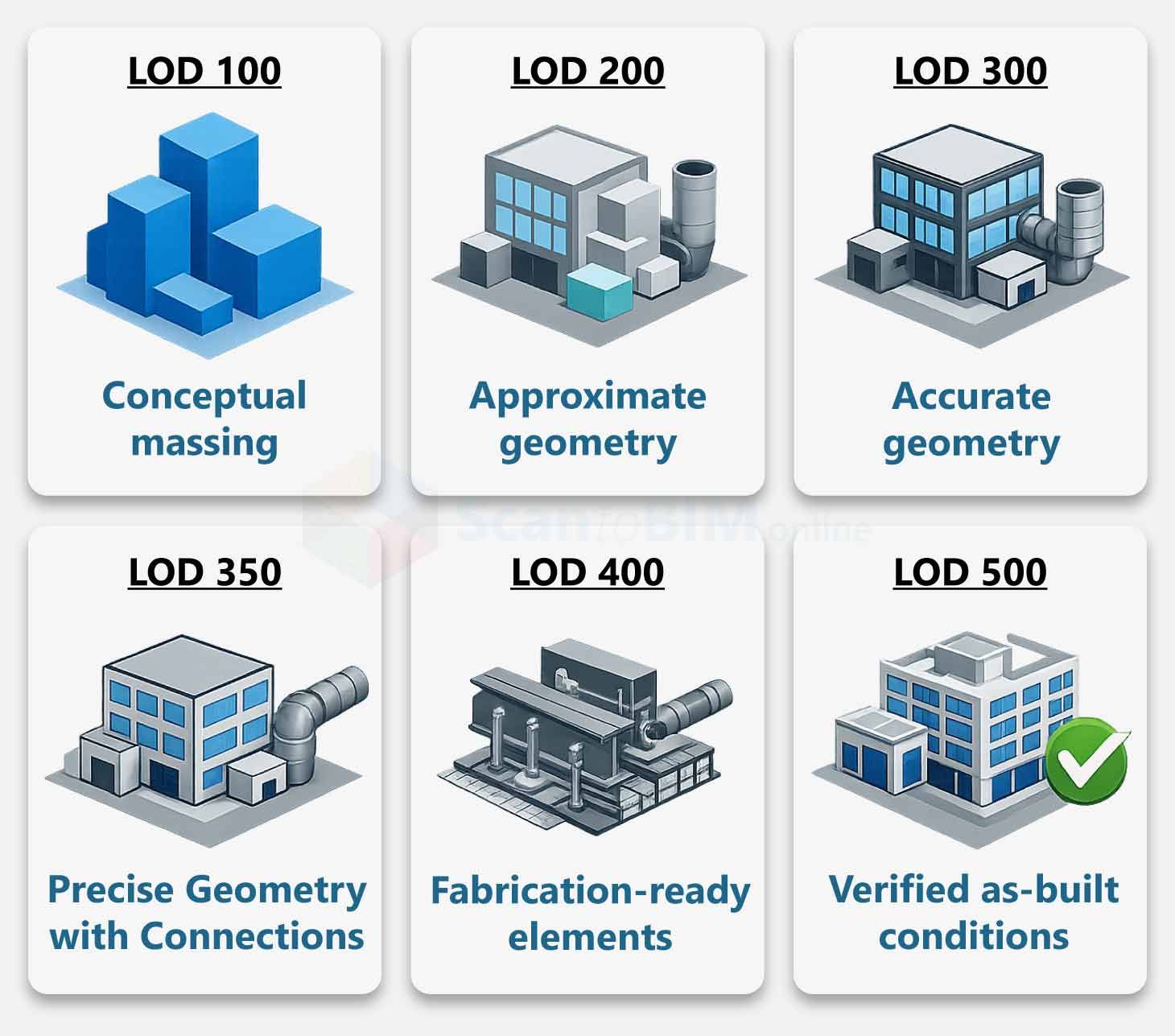
LOD 100 – Conceptual massing and spatial envelopes; no verified dimensional reliability.
LOD 200 – Approximate geometry with generalized system representation and placeholder elements.
LOD 300 – Accurate size, location, and orientation of elements with defined system relationships suitable for construction coordination.
LOD 350 – Inclusion of interfaces between building systems (e.g., wall-to-structure, duct-to-beam conditions).
LOD 400 – Fabrication-ready components including connection detailing, supports, and installation-level specificity.
LOD 500 – Verified field conditions reflecting measured as-built geometry for operations and facility management.
Levels of Development create clear benchmarks for model geometry precision and structured information content. In U.S. commercial renovation, most projects require LOD 300–350 for dependable coordination, while hospitals, data centers, and industrial retrofits often demand selective LOD 400 in high-density MEP zones. Providers should clarify how scanned data is translated into defined LOD outputs. whether Level of Information is embedded within element parameters and how modeling assumptions are formally recorded. Construction Industry include references such as BIMForum LOD Specifications, American Institute of Architects E202 guidance, National Institute of Building Sciences NBIMS and ISO 19650 frameworks.
Turnaround Time & Project Scalability
| Parameter | Specific Benchmark / Metric |
|---|---|
| Small Commercial Building | 1–3 weeks delivery |
| Mid-Size Facility | 2–4 weeks delivery |
| Large Campus / Infrastructure | 3–6 weeks delivery |
| Square Foot Pricing | $0.15–$0.35 per sq. ft. |
| Hourly Rate | $150–$250 per hour |
| Contract Model | Fixed project-based packages |
Scalability is determined by quantifiable production inputs: scan volume (e.g., 200–1,000+ registered scans), point density (5–10 mm spacing in MEP zones), and discipline-specific LOD distribution (e.g., architectural LOD 300, MEP LOD 400). High-capacity firms structure production through zone-based modeling segmentation (by floor or gridline), parallel discipline modeling teams, and batch-based QA review cycles. For fast-track projects, scalable providers release partial federated models. While continuing downstream modeling, allowing coordination to begin before full project completion.
Questions to Ask Before Hiring
1. What RMS registration accuracy do you guarantee for commercial terrestrial scan projects?
2. What model to cloud deviation tolerance do you contractually commit to for LOD 300 and LOD 400 deliverables?
3. How many registered scans per week can your team process?
4. At LOD 400, do you model pipe slopes, duct insulation thickness, and hanger spacing to actual field dimensions?
5. Are all elements created as native parametric families in Autodesk Revit, or are mesh/imported solids used?
6. Do you provide a formal deviation analysis report with section-based tolerance checks before final delivery?
7. What is your turnaround time for 100,000 sq. ft. LOD 300 renovationproject ?
8. Who retains ownership of the native Revit model and E57 point cloud data upon project completion?
List of Notable Scan to BIM Companies in the USA
The U.S. market includes several nationally recognized firms delivering reality capture and BIM conversion services across commercial, infrastructure, healthcare, and industrial sectors. When evaluating the best scan to BIM company, it is important to distinguish between hardware manufacturers and full-service modeling providers. The following organizations are frequently referenced among leading scan to BIM companies USA, each offering different technical strengths and production capacities.
HDR
HDR operates nationwide scanning teams across all 50 states, supporting infrastructure and healthcare projects. The firm utilizes Cyclone-to-Revit workflows, structured QA/QC validation, and typically delivers mid-scale commercial facilities within a 2–4 week timeframe.
WSP
WSP integrates laser scanning with CAD to BIM conversion using RealWorks and Revit platforms. The company incorporates AI-assisted feature extraction, VR visualization, and advanced coordination workflows, with delivery windows commonly ranging from 3–5 weeks.
ScantoBIM.Online
ScantoBIM.online is a dedicated Scan to BIM service provider focused on commercial renovations and infrastructure assets, with structured LOD 300–400 modeling workflows. The firm emphasizes coordinated architectural, structural, and MEP models, phased deliverables, and deviation-validated QA processes to support fabrication-level accuracy and renovation sequencing.
Jacobs
Jacobs offers cross-industry Scan to BIM services with structured LOD-managed architectural, structural, and MEP modeling. The firm integrates GIS coordination and cloud collaboration environments, supporting 2–4 week turnaround targets for mid-scale assets.
AECOM
AECOM operates centralized reality capture labs with drone-based LiDAR capability and sensor-based validation systems. The company integrates Point Cloud to BIM outputs into IoT-enabled digital twin platforms, typically delivering large-scale facilities within 3–6 weeks.
Final Checklist Before You Decide
Prior to contract award, align documented LOD targets, tolerance thresholds, and deliverable formats with your project BIM Execution Plan. Confirm that registration accuracy, deviation reporting, and coordinate alignment procedures are formally included in scope. Validate production capacity and data governance terms alongside pricing structure.
Pre-Contract Technical Checklist
- LOD scope (300 / 350 / 400) formally defined in writing
- Modeling tolerance contractually stated
- RMS registration report included in deliverables
- Model-to-cloud deviation validation process documented
- Sample native BIM model technically reviewed (not just rendered output)
- Coordinate system alignment confirmed
- QA/QC workflow and final sign-off authority identified\
- Weekly production capacity validated
- Pricing structure broken down by LOD and deliverable type
- COBie / IFC / 2D drawings clarified within base scope
- IP ownership of Revit model and E57 files defined
- Data hosting location and security agreements documented
- Timeline milestones and phased delivery schedule confirmed
- References from similar healthcare, airport, or industrial projects reviewed
Conclusion
At ScanToBIM.Online we deliver precision-driven Laser Scan to revit services aligned with your required LOD, tolerance thresholds, and project phase. Whether for renovation coordination, fabrication-level detailing, or facility asset management. Our workflows integrate verified registration accuracy, structured QA validation, and discipline-specific modeling to support measurable project outcomes.
Frequently Ask Question
1. How do I choose the right Scan to BIM company in the USA?
Choose a company that clearly states its scan accuracy, modeling tolerance, LOD scope, QA process, and delivery timeline. We provide written accuracy commitments, deviation reports, and defined LOD 300–400 modeling so you know exactly what you’re getting.
2. How much do Scan to BIM services cost in the United States?
Most projects cost depending on LOD and MEP complexity. Some scopes are priced hourly We offer fixed pricing based on your square footage, required LOD, and deliverables.
3. What level of detail (LOD) should a Scan to BIM company provide?
We help you select the right LOD 100-500 based on whether your goal is design coordination, prefabrication, or facility management.
4. Do Scan to BIM companies provide both laser scanning and BIM modeling services?
Some companies only provide scanning. We provide both laser scanning and BIM modeling, delivering native models in Autodesk Revit along with deviation validation and structured outputs.
5. Is Scan to BIM necessary for renovation and retrofit projects?
Yes for commercial renovations with dense MEP systems. Accurate existing-condition models reduce clashes, support fabrication planning, and improve coordination. We convert your scan data into verified BIM models ready for design and construction use.